Navigating Allergies in the Nail Industry & The Importance of Professional Gel Nail Lamps
As professional nail technicians, client safety must always come before aesthetics or trends. One of the most serious health considerations within our industry is the risk of allergic reactions. Nail allergies can be distressing for clients, damaging to the natural nail, and challenging for technicians to manage if not handled correctly. Understanding how allergies develop, how they can be prevented, and how to respond professionally is essential to maintaining a safe, ethical, and reputable practice.
Safe practice isn’t about limitation, it’s about confidence. When you understand how your products work, how curing impacts safety, and how to apply with precision, you create services that are not only beautiful, but reliable, repeatable and trusted. These foundations are what allows nail technicians to build long-term client relationships and sustainable careers.
Key Takeaways:
- Allergies can’t be reversed: Prevention through safe working practices is essential.
- Improper or under-curing is a major cause of sensitisation: Issues such as incorrect curing times, degraded lamps & using mismatched lamp and product systems can all increase allergy risk.
- Correct curing is critical: using the right lamp, correct settings and appropriate layer thickness reduces the risk of sensitisation.
- Use the manufacturer-approved lamp: To ensure full polymerisation and avoid exposure to reactive monomers.
- Avoid Skin Contact: Uncured gel on the skin is one of the highest-risk triggers.
Clean, precise application that avoids skin contact protects both client and technician.
- Stop the service if symptoms appear: If a client shows signs of a reaction, discontinue treatment and advise them to seek medical guidance.
- Record and follow up: Keeping accurate notes supports professionalism, ensures health and safety compliance, and helps protect both client and technician.

Understanding Allergies in the Nail Industry
An allergy is an immune response that develops after exposure to certain substances, often over time. In nail services, allergic reactions are most commonly linked to repeated contact with uncured or improperly handled nail products.
There is no single product or ingredient that causes allergies. Any reactive monomer found in gel, acrylic or adhesive systems has the potential to cause sensitisation in some individuals. This is why safe application, correct curing and controlled exposure are critical across all systems.
Symptoms Associated with Nail Product Allergies
Reactions vary and can appear during a service or days later. Common signs include:
- Redness, itching, swelling or blistering around the cuticle or surrounding skin.
- Changes to the natural nail such as thinning, lifting or onycholysis.
- In rare cases, respiratory irritation from dust or fumes.
A client or technician may have no reaction initially, then suddenly experience symptoms after repeated exposure. Similar symptoms may be caused by trauma, infection, photo-onycholysis, or other underlying issues. Any suspected reaction should be handled calmly and professionally, with referral to a medical professional.
Why Nail Allergies Occur
Rather than focusing on individual ingredients, it’s more accurate to understand how exposure occurs.
- Improper application and incomplete curing which can occur when: the lamp is not designed for the gel system, curing times aren’t followed, the lamp output has degraded over time product is applied too thickly, or when pigments, additives or formulas are mixed across systems. A gel that appears hard on the surface may still be under-cured beneath, leaving reactive monomers in contact with the nail or skin.
- Adhesives used for tips, wraps or soft gel systems may cause reactions if misused.
- Primers, dehydrators and cleansers can be irritating if overused or allowed to contact skin repeatedly.
- Repeated and prolonged exposure to uncured or partially cured products increases the likelihood of sensitisation for both clients and techs.
- Mixing products from different brands can introduce compatibility issues. Each system is formulated to work as a complete chemistry, including base, colour, top coat, and lamp.
- Not wearing appropriate protective gloves
- Inadequate dust control during filing or removal
Understanding these causes allows technicians to work proactively rather than reactively. By applying products exactly as designed, using complete systems, controlling exposure and maintaining a clean working environment, the risk of sensitisation can be significantly reduced for both clients and technicians.
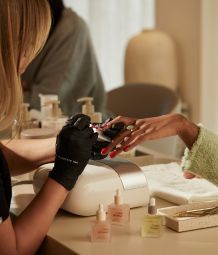
The Importance of Gel Nail Lamps in Correct Curing
Using the correct lamp for your gel system is essential for client safety and proper curing. Investing in the right lamp and following manufacturer‑approved curing times ensures every layer cures fully and reduces the risk of under‑ or over‑curing. A lamp engineered for your products doesn’t just improve wear — it protects nail health while reinforcing trust, reliability and long‑term confidence in your services.
When technicians are confident in their curing process, they remove uncertainty from their services. Correct curing supports consistent wear, protects nail health, and allows you to stand behind your work with confidence — a key factor in client trust and professional credibility.
Curing with TGB Systems
To support safe practice, all TGB gel and BIAB™ systems are thoroughly tested and validated for use with our own gel nail lamp. This ensures that every layer of product cures as intended when used with the recommended system.
Adhering to the recommended curing guidance ensures safe curing, contributes to longer-lasting results, and consistently beautiful finishes — all while upholding professional safety standards for both clients and technicians.
Even with best practice, technicians must be prepared to respond professionally if a concern arises. Knowing what to do and doing it calmly reinforces your role as a responsible, educated professional.
If You Suspect a Client May Be Having a Reaction
Stay Calm and Professional
If a client reports discomfort or you observe unusual skin changes, pause the service. Do not panic and do not diagnose.
Stop the Service
Discontinue the treatment to prevent further exposure.
Remove Products Safely
If appropriate, remove products gently using correct methods to minimise further irritation.
Advise Medical Consultation
Clients should be advised to seek medical advice and/or allergy testing from a qualified professional.
Do Not Continue Treatment
No further nail services should be carried out until allergy testing has been completed and results are available.
Once results are known, ingredient lists can be checked carefully to determine whether a safe service is possible. If not, the treatment must be declined.
Record and Follow Up
Document the incident, including products used and observed symptoms. Follow up with the client to check their wellbeing and maintain professional communication.
Daily Habits of a Safe & Skilled Nail Technician
While it’s essential to understand the risks and avoid unsafe habits, it’s just as important to feel confident in the positive steps that you can take every day to protect your clients and yourself. Safe practice isn’t restrictive — it’s empowering and reflects true professionalism.
Apply with precision: Work cleanly and intentionally, ensuring gel is placed exactly where it should be. If gel does make contact with the skin, remove it right away before curing.
Prioritise your own protection: Always wipe excess product onto a suitable surface or palette, not your gloves or skin. Wear gloves, use dust extraction, and maintain good ventilation.
Cure carefully with thin layers: Always cure for the full manufacturer-recommended time, complete polymerisation is essential for safe wear and long-lasting results. Keep layers thin, even, and consistent for more efficient curing.
These steps don’t just avoid problems, they build a foundation of trust, safety, and consistently high-quality work that clients can rely on.
These habits don’t just reduce risk, they define professional standards and support a career built on trust, safety and consistent results.
Professional Responsibility: Nail Allergies, Correct Curing & Safety Standards
Allergies cannot be reversed, cured or ignored. Our responsibility as nail technicians is not to promise solutions, but to work safely, ethically and within our scope of practice.
By understanding how allergies develop, respecting manufacturer guidance, and responding appropriately when concerns arise, we protect our clients, our careers and the integrity of the industry as a whole.
Working safely isn’t a barrier to creativity — it’s the framework that allows it to thrive.